B2B
Marketing

Strategy, content, and marketing systems

Human decision-making
+
AI efficiency
=
Knowledge brand

I work with B2B companies to turn complex expertise into clear positioning, compelling messaging and marketing that moves customers to act.

From understanding what makes your business worth choosing to communicating it across every touchpoint, I own the process: discovery, strategy, content, execution and measurement.

We clarify what makes your business worth choosing, make that message consistent across touchpoints, and build AI-powered workflows that put your knowledge to work.

Good products don’t sell themselves. Customers need to understand what they do, why they matter, and why they’re worth choosing.

I dig into the business, its product, its customers, and the market to identify meaningful points of differentiation—and mash them with what customers need, want, and value.

I turn those insights into marketing that:

  • Translates complex concepts into relatable narratives with clarity and conviction.

  • Blends rational value propositions with emotional benefits to earn a nook in the mind and a place in the heart of the target ICP.

  • Combines meaningful messaging that connects with resonant content that compels.

  • Moves prospects through every stage of the buying journey with strategic marketing and targeted content.

The result: Marketing that cuts through the noise, makes your value clear, and gives the right customers a reason to choose you.

  • Clear positioning and messaging: A distinct explanation of the product offering, who it serves, what makes it different, and why it matters to people who care.

  • Consistent communication: One underlying story carried across the website, sales conversations, proposals, campaigns, and content.

  • Greater discoverability: Structured, credible information that makes your business expertise easier for search engines and AI systems to find, understand, and reference.

  • A central knowledge source: A maintained company knowledge base containing positioning, messaging, product information, proof points, terminology, and approved content.

  • Repeatable marketing systems: AI-powered workflows for research, content production, repurposing, lead management, and follow-up.

You:

  • Have a great product but fuzzy or generic messaging.
  • Possess technical expertise that doesn’t translate into a compelling story.

  • Want one person to own strategy, execution, and reporting.
  • Are willing to shape the voice and positioning (or have an established one that needs to be amplified).

Me

I’m a copywriter who evolved into a strategist, and became a storyteller.

  • 8 years developing brand voice, positioning, messaging, and content
  • 2 years building AI systems to standardize and scale work.

I explore B2B buying psychology, dig into customer motivations, map the buying journey, and translate what I learn into narratives that make complex products easier to understand and choose.

  • Intellectually curious, first-principles reasoner, second-degree thinker.
  • Speak candidly, express clearly, think strategically.
  • Bias for action, balancing strategic vision with creative execution.
  • Experience: Brand strategy, copywriting, product, growth.
  • Expertise: Shaping a voice, mining small data, and translating complex technical concepts into clear narratives.

  • Methodology:  Leveraging a macro-view with micro-insight to curate content for audiences, channels, and search engines.

  • Method:  Diving deep into a company’s DNA, capturing its vision, distilling its essence, and translating features into benefit-driven narratives that connect and drive action.

  • Writing style:
    informative
    authentic
    percise
    direct
    clear

  • Philosophy: Ask the questions that matter, hold strong opinions loosely, write with conviction.

    Clear

    Authentic

    Simple

    Human


    AI:

    I leverage human expertise and AI efficiency throughout the marketing strategy: 70% human creativity and strategic thinking, and 30% AI-powered workflows and optimization. Tools include Fathom, Claude, Perplexity, Gemini, Grok, Jasper, Surfer, Clearscope, and Notion for research, analysis, and content management.
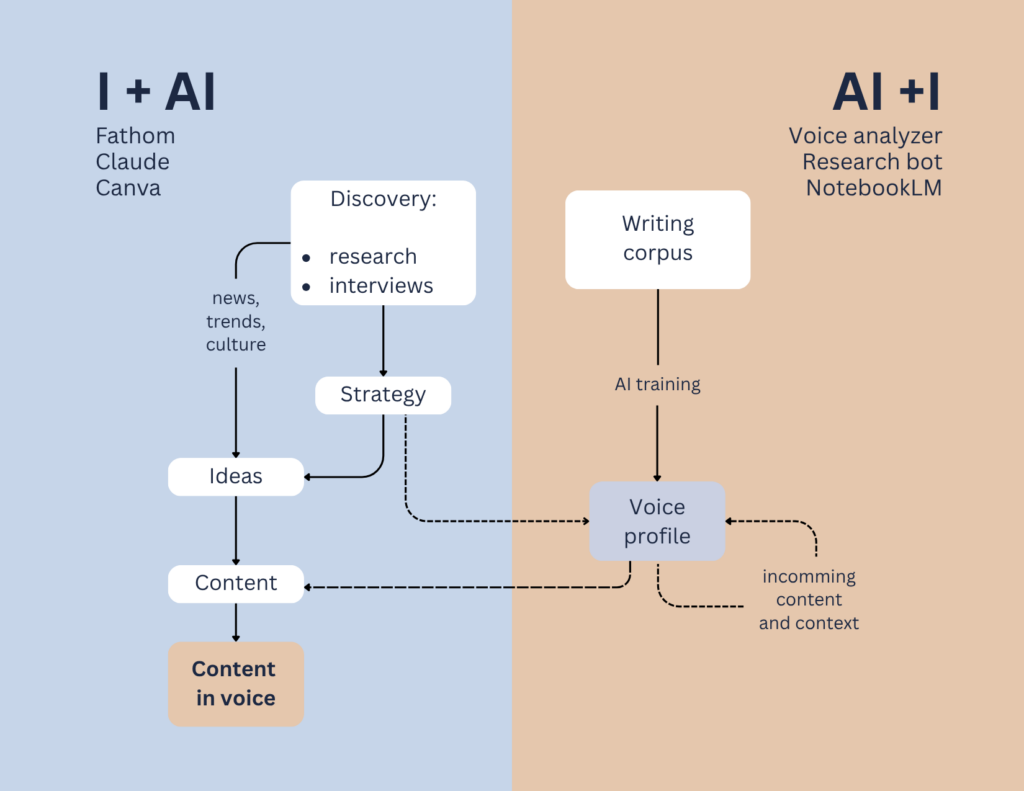
Every engagement is customized to the company’s goals, challenges, and capabilities.

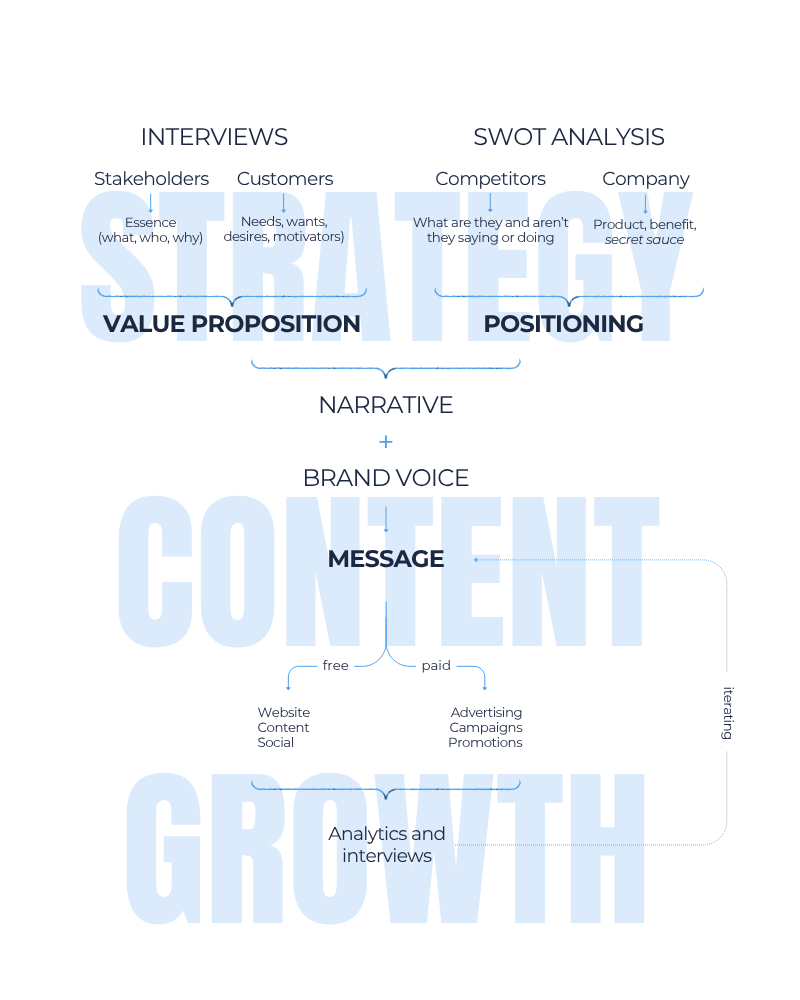
1. Discovery

  • Interviewing stakeholders to define objectives, challenges, business model, KPIs, differentiation, brand essence and driving principles, value proposition, and ICP.
  • Interviewing customers and prospects to understand problems, solutions, goals, fears, pain points, motivators, and decision-making criteria.
  • Reviewing existing marketing, sales processes, content, tools, and data.

  • Researching customer needs, competitors, industry trends, and cultural context.

  • Mapping the customer journey from awareness to purchase and beyond.

  • Creating customer profiles and mapping the customer journey from awareness to purchase and beyond.

Output: A clear picture of the business, its customers, its market, and its opportunities.


If you wish to persuade me,
you must think my thoughts,
feel my feelings, and speak 
my words.
— Cicero


2. Research, Analysis & Opportunity Mapping

Finding where the business can stand out and where marketing can make the greatest difference.

  • Assessing online presence, competitor positioning, industry trends, and cultural context.

  • Identifying whitespace opportunities undercommunicated differentiators where the brand can own a unique position.

  • Assessing competitor positioning and existing market narratives.

  • Evaluating website visibility, messaging, and lead-conversion problems.

  • Identifying high-value marketing and operational workflows.

  • Prioritizing opportunities by business impact, cost, and implementation effort.

Output: A prioritized strategy and implementation roadmap.


3. Distill & Define

Synthesizing insights into a clear brief:

  • What is the product?

  • Whom is it for?

  • Why do they choose it?

Output: A clear definition of the basics and company-wide framework.


4. Positioning & Messaging

  • Translating technical features into customer-relevant benefits.

  • Developing positioning, value propositions, and messaging architecture.
  • Testing messages with target audiences, refining based on what works (resonance, recall), and selecting the optimal version for deployment.

Output: A positioning and messaging framework that guides communication across the business.


5. Brand Guide & Implementation

  • Establishing (or refining) brand voice, tone, and language guidelines.

  • Developing a story framework and creating multiple content drafts in the company’s voice and style. 

  • Codifying messaging, voice, and visual identity.

  • Creating guidelines for consistency across touchpoints.


6. Content & Execution

  • Deploying messaging across website, social, and product content.
  • Creating thought leadership, articles, case studies, and campaigns.

  • Building sales collateral, pitch decks, and objection-handling frameworks.

  • Developing SEO and AI-search content.

  • Repurposing expertise into multiple formats and touchpoints.

  • Planning, managing, and maintaining editorial calendars across relevant channels.

Output: Consistent, strategically produced content across the customer journey.


7. Systems & Implementation

  • Consolidating company knowledge into a central, maintainable source.

  • Building AI agents and workflows around approved company information.

  • Automating content research, production, repurposing and distribution where appropriate.

  • Developing lead qualification, inquiry management and follow-up workflows.

  • Connecting existing tools and test workflows against real scenarios.

  • Establishing documentation, safeguards and maintenance processes.

Output: Working systems that reduce manual effort, preserve company knowledge, and standardize execution.


8. Measuring & Optimizing

  • Tracking qualified inquiries, lead conversion, and sales support effectiveness.
  • Measuring content production, engagement, and conversion.

  • Monitoring website and AI-search visibility.

  • Evaluating time saved, workflow adoption, and operating costs.

  • Gathering customer and sales feedback.

  • Iterating based on performance and business priorities.

Output: Measurable improvements and a marketing system that evolves with the business.
Strategic Foundation

  • Continuous collaboration with product teams to identify differentiation and market opportunities.

  • Market positioning and messaging architecture development.

  • Audience research to convey benefits in language that resonates.
  • Business and product positioning.

  • Audience research and customer profiles.

  • Value propositions and messaging architecture.

  • Brand voice, identity and communication guidelines.

  • Category creation and market-shaping narratives.

  • Competitive analysis and differentiation.


Content & Messaging

Core Content Creation

  • Blogs, case studies, whitepapers, guides, infographics.
  • Landing pages and website copy.
  • Email campaigns and social content.
  • Executive ghostwriting and thought leadership.

Strategic Content Development

  • Messaging frameworks, market-shaping narratives, and selling propositions.

  • Persona-specific messaging and customer stories.
  • Comparative content and objection handling.

  • Sales collateral (one-pagers, pitch decks, persona messaging).

Full-Funnel Execution

Top of Funnel (Awareness, Lead & Demand Generation)

  • Thought leadership and category creation content.

  • SEO/GEO content for organic traffic.

  • AIO content to be featured in AI search answers.
  • Organic social presence.

Mid-Funnel (Trust, Rapport & Consideration)

  • Comparative content and case studies.

  • Educational and industry content and resources (whitepapers, guides).

  • Nurture email sequences.

  • Account-based content for targeted accounts.

Bottom of Funnel (Conversion)

  • Landing pages and conversion optimization.

  • Campaign execution and testing.

  • Lead-generation content.

  • Sales enablement.

Post-Purchase (Retention, Loyalty & Advocacy)

  • Customer success content.

  • Retention and upsell communications.

  • Community and brand advocacy initiatives.

Depending on the engagement, this can include:

  • GTM & Product Marketing: Technical positioning, audience definition, product narratives, launches and market-shift communications.

  • Strategic Messaging & Sales Enablement: Differentiated messaging, objection-handling frameworks, sales playbooks and collateral for complex B2B deals.

  • Content & Campaigns: Editorial strategy, expert-led technical content, executive thought leadership and omnichannel campaigns that generate demand and pipeline.

  • Brand Stewardship: Brand voice and messaging guidelines, content governance and systems that maintain consistency across touchpoints.

  • Marketing Operations: Cross-functional coordination between Marketing, Product, Sales and Customer Success; editorial planning, campaign execution and content repurposing.


Channels & Operations

  • Owned: Website management and content updates.

  • Earned: SEO/GEO optimization and organic search and social growth.

  • Paid: Advertising and campaign management across relevant channels.

  • Social: Content creation, distribution, advertising and community engagement.

  • Offline: Tradeshows, events and experiential marketing.


AI & Marketing Systems

  • Central company knowledge bases and competitive intelligence systems.

  • Brand voice AI agent development.

  • AI-powered research and content workflows.

  • Content repurposing and distribution automation.

  • Lead qualification and follow-up automation.

  • Workflow integration, documentation and optimization.


Outcomes & Measurement

General

  • Clearer positioning, messaging and customer profiles.

  • Consistent brand voice and communication across channels.

  • Reduced marketing complexity and operating costs.

  • Greater awareness, discoverability and qualified lead generation.

  • More consistent content production and smarter repurposing.

  • Better alignment between Marketing, Product and Sales.

  • Improved conversion and marketing ROI.

First 30 Days

  • Auditing existing content, messaging, and marketing processes.

  • Establishing positioning, messaging, and foundational systems.

  • Finalizing content frameworks, editorial calendar, and briefing templates.

First 90 Days

  • Publishing 30+ content assets across channels, according to the strategy and plan.

  • Increasing content production speed using AI workflows.

  • Establishing repeatable systems for content production, distribution, and measurement.

Success Metrics

  • Social reach and engagement.

  • Landing page conversion rates.

  • Qualified lead generation and sales support effectiveness.

  • Content production and revision time.

  • Website and AI-search visibility.

  • Workflow adoption, efficiency and operating costs.

  • Content shipped within five business days from brief to publish.

Planning & Optimization

  • Rolling 30-day editorial calendars aligned with campaigns and launches.

  • Cross-functional collaboration across Product, Design, Sales, and Customer Success.

  • KPI tracking across awareness, reach, resonance, conversions, and brand equity.

  • Campaign testing, performance reviews, and continuous optimization.

Quality and substance over noise. Sales over vanity metrics. 

Strategic Alignment Sprint

1. Clarity Call

Socratic discovery to understand where you’re stuck, what’s misaligned, and what’s costing you time or trust.

Input: team/org context, recent outcomes, roadmap artifacts.

Output: friction map, priority hypothesis, quick-win insight.

2. Pressure-Testing the Core

Next, I dig into your operating model, product thinking, user journey, and customer comms. We map what’s working, what’s fuzzy, and what’s missing.

Input: decision-making flow.

Output: operating model snapshot + clarity gaps.

3. Sprint Towards Clarity

Using the insights, I run a focused working session or weeklong sprint to align stakeholders, define outcomes, and rebuild a strategic path forward.

Input: priorities, objectives, product roadmap.

Output: short-term plan, prioritized initiatives, buy-in-ready strategy.

4. Delivery

An actionable blueprint—insights and strategy packaged into a clear narrative, ready to present to the team, investors, and customers.

Deliverables: strategy brief, sprint summary, KPI alignment, next moves.

5. Embed + Scale

Need more than a sprint? Plug me into your org as an embedded extension of your team.

Input: collaboration.

Output: sustained clarity, message resonance, content that translates into sales.


Your Business in 7 Words

Can you explain your business in seven words? People won’t sit through a full pitch, and you only get one first impression. Short and sharp messaging gives customers a reason to believe, investors a reason to bet, and employees a reason to row together.

1. Discovery Call

Socratic discovery to uncover the essence.

2. Customer Interviews

What do they care about, what are they missing, and what matters to them?

3. Synthesizing

Combining knowledge and insight into a brief and trimming the summary into succinct message options.

4. Delivery

Five 7-word message options.

5. Embed + Scale

Need more than a sprint? Plug me into your org as an embedded extension of your team.

Input: collaboration.

Output: sustained clarity, message resonance, content that translates into sales.


Voice and Content Refresh

What you say and how you deliver the message determine what people feel, think, and do. Consistency and relevancy are key.

Your website is your company’s storefront. Even if most of your leads don’t come from the website, all of them visit it. It’s an opportunity to connect and shape perception.

1. Discovery & Review

What works, what doesn’t, and what needs to happen.

Input: website, target audience, goals.

Output: copy and UX optimization suggestions, potential friction points.

2. Planning

Summarizing voice and adjusting based on the ideal positioning and desired perception.

3. Refreshing

Rewriting the content.

4. Delivery

Voice guide, revised website content.


Calling You To Action

Give me two minutes to look at your website, and I’ll tell you the single easiest way to boost the good metrics and reduce the bad ones.

  • Retainer: Ongoing marketing planning and execution with predetermined asset volumes and hours.
  • Fractional: Embedded strategic partner, leading product marketing and driving outcomes.
  • Project-Based: Specific initiatives like brand positioning, website refresh, or campaign development.
  • Sprint: Focused working sessions to align stakeholders and build tactical paths.
  • Content calendar ownership: Starting from $1,500 per/m.

Good content is the gift that keeps on giving. Publish once and people will interact with it forever.